How to Interpret the Celtic Cross Spread
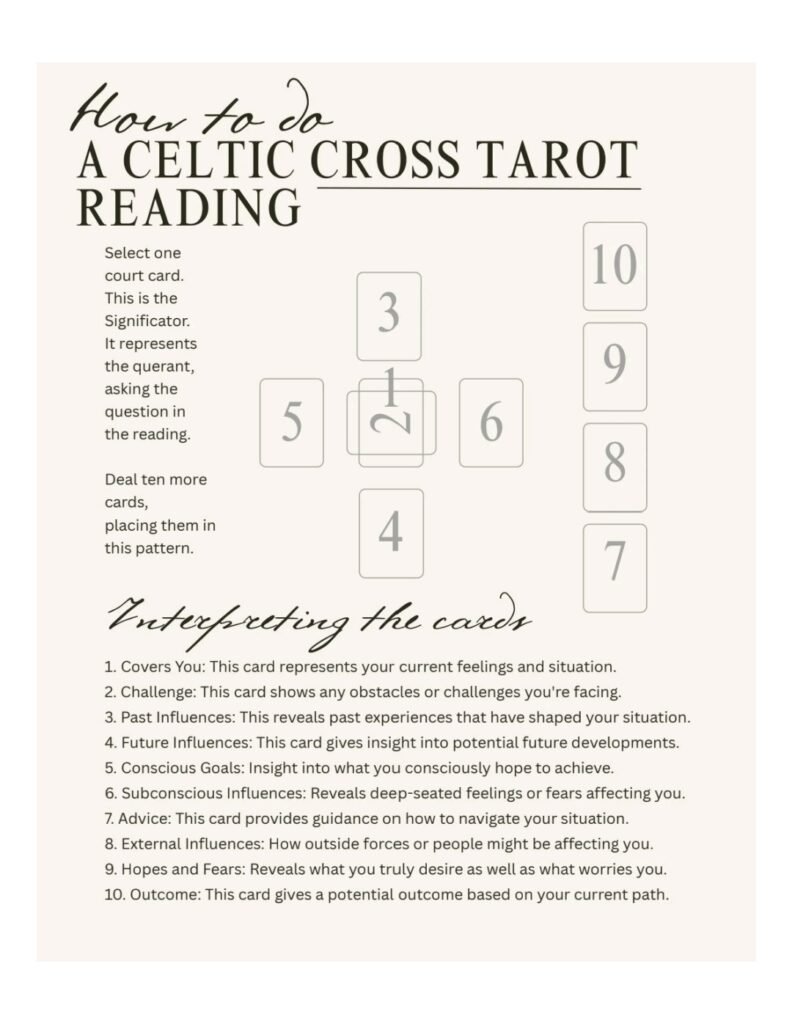
A Celtic Cross reading starts by asking an open, thoughtful question about your life. You begin by placing the first card down to represent your current situation, then lay the second card across it. This central pair shows the heart of the matter—where you are right now and the main challenge or obstacle you are dealing with.
Next, you place four cards around the center to create a cross. The bottom card uncovers your hidden feelings and subconscious habits, while the top card shows your conscious goals. The card to the left highlights the past lessons you are leaving behind, and the card to the right reveals your immediate next step. This section helps you see if your underlying beliefs match what you consciously want to achieve.
Finally, you lay four cards in a vertical line to the right of the cross to add context. These cards show how you view yourself, how other people and your surroundings affect you, and your deepest hopes and fears. The very top card shows the most likely outcome based on your current path. This outcome is not set in stone, but serves as a guide to help you make better decisions and shift your direction.
Using the Celtic Cross for personal insight turns a traditional fortune-telling spread into a practical mirror for self-reflection. Instead of asking what the future holds, you use the 10 cards to unpack how you think, uncover blind spots, and navigate decisions with greater clarity.
1. Frame an Open-Ended Question
Personal insight begins with asking the right type of question. Avoid rigid “yes/no” or predictive queries, and lean into reflective, empowering prompts:
Instead of: “Will I get the new promotion?”
Ask: “What internal and external dynamics are shaping my current career path?”
Instead of: “Is this relationship going to last?”
Ask: “How can I show up more authentically in my relationship right now?”
2. Read the Spread as a Three-Part Story
Rather than getting lost in ten separate definitions, break the layout down into three intuitive chapters:
The Heart of the Matter (Cards 1 & 2):
Card 1 (Present State) & Card 2 (Immediate Challenge) reveal the tension you are currently managing.
Reflection prompt: What friction in my life is calling for my attention right now?
Your Inner Compass (Cards 3, 4, 5, & 6):
Card 3 (The Root) shows subconscious beliefs or baseline habits.
Card 4 (Passing Past) highlights what you have outgrown and need to release.
Card 5 (The Crown) represents your conscious goals and ideals.
Card 6 (Near Future) marks the natural next step right ahead of you.
Reflection prompt: Do my underlying beliefs (Card 3) support or sabotage what I say I want (Card 5)?
The Outside World & Outcome (Cards 7, 8, 9, & 10):
Card 7 (Your Attitude) reflects how you view yourself in this situation.
Card 8 (Your Environment) shows external influences, resources, or other people’s perspectives.
Card 9 (Hopes & Fears) mirrors your inner emotional stakes and hidden anxieties.
Card 10 (Projected Outcome) represents where your current momentum is leading.
Reflection prompt: Am I projecting my private worries (Card 9) onto my external reality (Card 8)?
3. Practical Habits for Insightful Readings
Treat Card 10 as Momentum, Not Destiny: If the outcome card isn’t what you want, treat it as a weather forecast. Look back at Card 7 (Your Attitude) and Card 2 (The Challenge) to see what behaviors or perspectives you can change to redirect the outcome.
Lean Into Surprises: The cards that feel confusing or ill-fitting at first glance are usually pointing directly to a subconscious blind spot.
Keep a Brief Journal: Write down one actionable takeaway or question to carry through the week rather than trying to memorize all ten cards.
Anatomy of the Spread
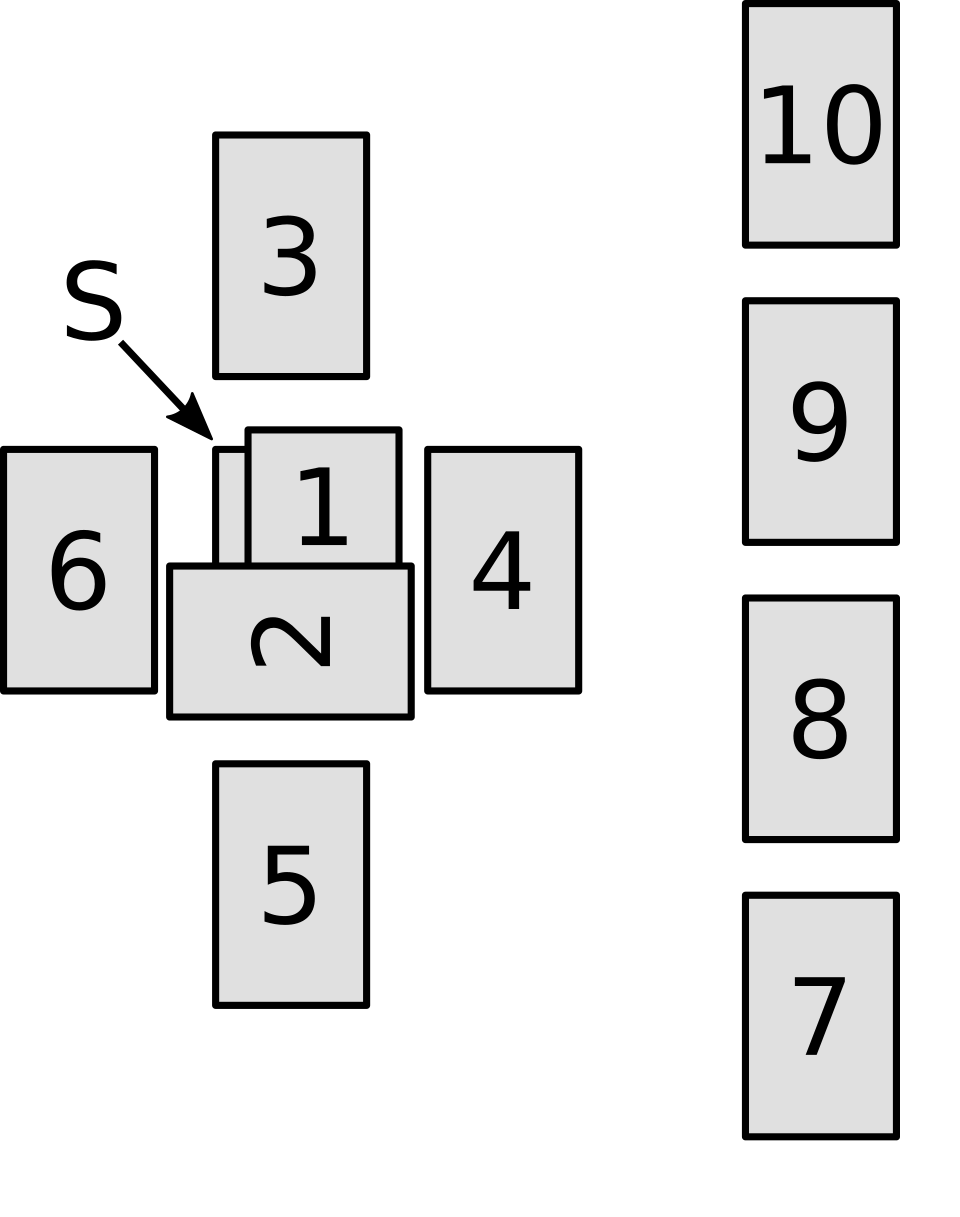
The spread divides into two distinct visual and thematic components: The Cross (inner dynamics) and The Staff (outer trajectory).
The Cross & Circle (Cards 1–6): Focuses on the core inquiry. Card 1 represents the querent’s present state, crossed by Card 2 (the immediate challenge or catalyst). Surrounding cards map the conscious ideal (above), subconscious foundation (below), receding past (left), and emerging near future (right).
The Staff or Pillar (Cards 7–10): Positioned vertically alongside the cross, this column contextualizes the situation. It maps the querent’s self-perception (Card 7), external environment and relationships (Card 8), psychological hopes and anxieties (Card 9), and the ultimate projected outcome (Card 10).
The Celtic Cross
Visual guide to Celtic Cross spread and its card positions.
[Card 5: Conscious Crown]
▲
│
[Card 4: Past] ─── [1 & 2] ───► [Card 6: Near Future]
│
▼
[Card 3: Subconscious Root]
Step 1: Analyze the Central Nexus (Cards 1 & 2)
The reading begins at the intersection of the querent’s present state and the primary energetic catalyst.
The Core Dynamic: Card 1 represents the immediate focus or present reality; Card 2 acts as the crossing factor—the obstacle, amplifier, or necessary friction.
Step 2: Read the Cross Axes (Cards 3, 4, 5, & 6)
The four cards surrounding the central cross form two distinct diagnostic axes: the Vertical Consciousness Axis and the Horizontal Timeline Axis.
Step 3: Decode the Staff of Context (Cards 7, 8, 9, & 10)
The vertical pillar on the right contextualizes the central inquiry within the querent’s internal psychology and external environment.
Card 7 and Card 8: Shows how the querent views themselves (Card 7) and how the environment or others respond (Card 8). A discrepancy here highlights miscommunication, imposter syndrome, or unseen external leverage.
The Psychological Mirror Card 9: Card 9 represents hopes and fears—in tarot, these are often two sides of the same coin. Compare Card 9 directly to Card 3 (Root) to identify underlying anxieties driving the querent’s stated hopes.
The Resolution (Card 10): Card 10 is the culmination of the vector created by the preceding nine cards, not an unchangeable fate.
| Section | Cards | Focus |
| The Core | 1 & 2 | The central problem and its immediate obstacle |
| The Circle | 3, 4, 5, 6 | Time axis (past/future) and consciousness axis (above/below) |
| The Staff | 7, 8, 9, 10 | Context, external pressures, inner fears, and resolution |
The Celtic Cross – As described by A.E. Waite in The Pictorial Key to the Tarot
An Ancient Celtic Method of Divination.
This mode of divination is the most suitable for obtaining an answer to a definite question. The Diviner first selects a card to represent the person or, matter about which inquiry is made. This card is called the Significator. Should he wish to ascertain something in connexion with himself he takes the one which corresponds to his personal description. A Knight should be chosen as the Significator if the subject of inquiry is a man of forty years old and upward; a King should be chosen for any male who is under that age a Queen for a woman who is over forty years and a Page for any female of less age.
The four Court Cards in Wands represent very fair people, with yellow or auburn hair, fair complexion and blue eyes. The Court Cards in Cups signify people with light brown or dull fair hair and grey or blue eyes. Those in Swords stand for people having hazel or grey eyes, dark brown hair and dull complexion. Lastly, the Court Cards in Pentacles are referred to persons with very dark brown or black hair, dark eyes and sallow or swarthy complexions. These allocations are subject, however, to the following reserve, which will prevent them being taken too conventionally. You can be guided on occasion by the known temperament of a person; one who is exceedingly dark may be very energetic, and would be better represented by a Sword card than a Pentacle. On the other hand, a very fair subject who is indolent and lethargic should be referred to Cups rather than to Wands.
If it is more convenient for the purpose of a divination to take as the Significator the matter about which inquiry is to be made, that Trump or small card should be selected which has a meaning corresponding to the matter. Let it be supposed that the question is: Will a lawsuit be necessary? In this case, take the Trump No. 11, or justice, as the Significator. This has reference to legal affairs. But if the question is: Shall I be successful in my lawsuit? one of the Court Cards must be chosen as the Significator. Subsequently, consecutive divinations may be performed to ascertain the course of the process itself and its result to each of the parties concerned.
Having selected the Significator, place it on the table, face upwards. Then shuffle and cut the rest of the pack three times, keeping the faces of the cards downwards.
Turn up the top or FIRST CARD of the pack; cover the Significator with it, and say: This covers him. This card gives the influence which is affecting the person or matter of inquiry generally, the atmosphere of it in which the other currents work.
Turn up the SECOND CARD and lay it across the FIRST, saying: This crosses him. It shews the nature of the obstacles in the matter. If it is a favourable card, the opposing
forces will not be serious, or it may indicate that something good in itself will not be productive of good in the particular connexion.
Turn up the THIRD CARD; place it above the Significator, and say: This crowns him. It represents (a) the Querent’s aim or ideal in the matter; (b) the best that can be achieved under the circumstances, but that which has not yet been made actual.
Turn up the FOURTH CARD; place it below the Significator, and say: This is beneath him. It shews the foundation or basis of the matter, that which has already passed into actuality and which the Significator has made his own.
Turn up the FIFTH CARD; place it on the side of the Significator from which he is looking, and say: This is behind him. It gives the influence that is just passed, or is now passing away.
N.B.–If the Significator is a Trump or any small card that cannot be said to face either way, the Diviner must decide before beginning the operation which side he will take it as facing.
Turn up the SIXTH CARD; place it on the side that the Significator is facing, and say: This is before him. It shews the influence that is coming into action and will operate in the near future.
The cards are now disposed in the form of a cross, the Significator–covered by the First Card–being in the centre.
The next four cards are turned up in succession and placed one above the other in a line, on the right hand side of the cross.
The first of these, or the SEVENTH CARD of the operation, signifies himself–that is, the Significator–whether person or thing-and shews its position or attitude in the circumstances.
The EIGHTH CARD signifies his house, that is, his environment and the tendencies at work therein which have an effect on the matter–for instance, his position in life, the influence of immediate friends, and so forth.
The NINTH CARD gives his hopes or fears in the matter.
The TENTH is what will come, the final result, the culmination which is brought about by the influences shewn by the other cards that have been turned up in the divination.
It is on this card that the Diviner should especially concentrate his intuitive faculties and his memory in respect of the official divinatory meanings attached thereto. It should embody whatsoever you may have divined from the other cards on the table, including the Significator itself and concerning him or it, not excepting such lights upon higher significance as might fall like sparks from heaven if the card which serves for the oracle, the card for reading, should happen to be a Trump Major.
The operation is now completed; but should it happen that the last card is of a dubious nature, from which no final decision can be drawn, or which does not appear to indicate the ultimate conclusion of the affair, it may be well to repeat the operation, taking in this case the Tenth Card as the Significator, instead of the one previously used. The pack must be again shuffled and cut three times and the first ten cards laid out as before. By this a more detailed account of “What will come” may be obtained.
If in any divination the Tenth Card should be a Court Card, it shews that the subject of the divination falls ultimately into the hands of a person represented by that card, and its end depends mainly on him. In this event also it is useful to take the Court Card in question as the Significator in a fresh operation, and discover what is the nature of his influence in the matter and to what issue he will bring it.
Great facility may be obtained by this method in a comparatively short time, allowance being always made for the gifts of the operator-that is to say, his faculty of insight, latent or developed-and it has the special advantage of being free from all complications.
I here append a diagram of the cards as laid out in this mode of divination. The Significator is here facing to the left.
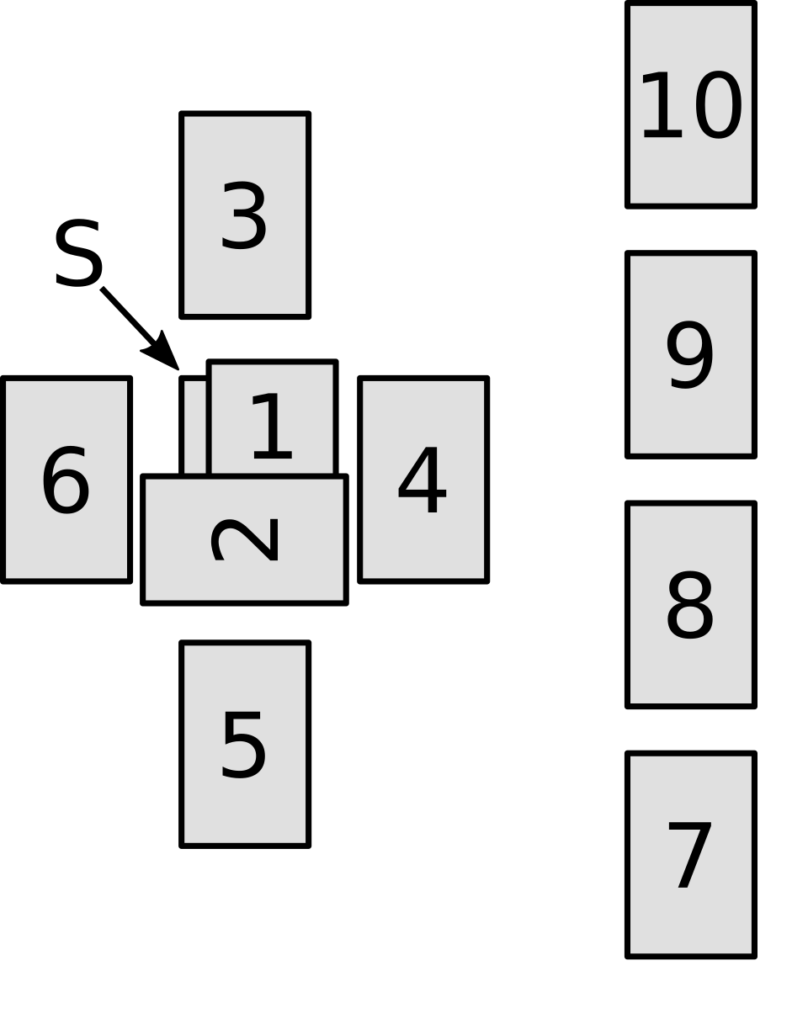
The Significator.
1. That covers him
2. What crosses him.
3. What crowns him.
4. What is beneath him.
5. What is behind him.
6. What is before him.
7. Himself.
8. His house.
9. His hopes or fears.
10. What will come.
Unlock Insight
Dive into the meanings behind each card in your Celtic Cross spread and find clarity.